
• Skip to primary navigation
  • Skip to main content
  • Skip to footer
Public School Forum

Public School Forum

A think-and-do tank committed to North Carolina public schools

  • Who We Are
    • Our Mission
    • Our Team
    • Our Board of Directors & Advisory Members
    • Work with Us
    • 2025 Impact Report
  • Our Centers
    • Dudley Flood Center for Educational Equity & Opportunity
    • NC Center for Afterschool Programs
    • NC Center for Resilience & Learning
  • Our Programs
    • Rural Teacher Leader Network
    • Education Policy Fellowship
    • Education Matters
    • NC Education Partners
  • Resources
    • Advocacy Hub
    • Policy Analysis, Briefs, and Research
    • Taxpayer-Funded Private School Vouchers
    • Op-Eds
    • Leandro v. State of NC: Background & Resources
    • Newsletters
  • News
    • Latest News
    • Op-Eds
    • Policy Corner
  • Donate
    • Donate
    • Our Supporters
  • Events
    • Education is Everyone’s Business
    • Eggs & Issues
    • Jay Robinson Education Leadership Award & Gala
    • Color of Education
    • Synergy
    • All Upcoming Events

Subscribe to Our Newsletters

Subscribe to the following newsletters:(Required)
Name(Required)
Email(Required)

Get Connected with an Expert

Name(Required)
What area(s) of expertise are you seeking?

North Carolina School Desegregation & Resegregation Timeline

North Carolina’s commitment to providing an equal public education to all students within the state began in 1776, when it included the right to public education in its original constitution. Following the landmark Brown v. Board of Education ruling in 1954, many Southern states engaged in immediate backlash, publicly proclaiming that they were not giving up their segregated system of schooling. While North Carolina’s approach to desegregation was less violent than other Southern states, it was by no means progressive, at least immediately following the Brown decision. However, 20 years after the Brown ruling, North Carolina would be recognized nationwide as the blueprint for successful integration strategies.

This timeline explores the policies, court cases, and important historical events that shaped not only school desegregation in North Carolina, but also the resegregation that has occurred in more recent years. This project attempts to highlight the lived experiences and stories of those who lived through desegregation, and fought to create equal schooling opportunities for all North Carolinians. To learn more about any of the topics covered in this timeline, please consult our resources page and literature review. We would like to thank Jenn Ayscue, Sandra Conway, Danita Mason-Hogans, and the UNC Southern Oral History Program for their support, expertise, and guidance throughout this project.

Timeline and literature review created by Flood Center School Desegregation Fellow Emma Miller.

School Desegregation and Resegregation in North Carolina
1776
December 18
North Carolina’s First Constitution Promises Public Education
In December 1776, North Carolina ratified its first constitution. Article XLI stated: “That a school or schools shall be established by the Legislature, for the convenient instruction of youth, with such salaries to the masters, paid by the public, as may enable them to instruct at low prices; and all useful learning shall be duly encouraged, and promoted, in one or more universities.”  
1896
May 18
Plessy v. Ferguson Ruling

plessyvferguson

On May 18th, 1896, Plessy v. Ferguson ruled that racial segregation was constitutional under the “separate but equal” doctrine.


1948
July 26
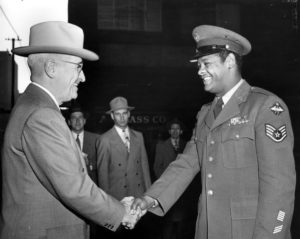
President Truman Desegregates the Military

On July 26th, 1948, President Truman signed Executive Order 9981, desegregating the American military and opening up opportunities for desegregation in every facet of American life.
1951
March 27
UNC Desegregates Law School

On March 27th, 1951, the McKissick v. Carmichael decision ruled in favor of the plaintiffs, four Black students seeking admission to UNC’s Law School, effectively desegregating the Law School. This ruling gave the precedent for other forms of higher education across the state to desegregate.

Plaintiff Floyd McKissick, the first Black student at UNC Law on why he chose UNC to help desegregate:


Public School Forum · Floyd McKissick on Why to Desegregate UNC

Audio Transcript
“One, we had attempted to…after I got out of the Army, I knew I was going into law. And during the time that I was in Atlanta, we had written the University of North Carolina and had gotten to reply to asking them–it was generally felt…there was a feeling in the air that people were going to be fair and teach you right, and that you were a returning veteran, and some schools were letting Blacks in that never had before. There were high quotas and veterans were getting quotas, so there was a feeling that North Carolina would do some of these things without being forced to do it. That feeling was later determined to be a false feeling, a false emotion that we had.”

1954
May 17
Brown v. Board Ruling

On May 17th, 1954, the Supreme Court ruling Brown v. Board of Education of Topkea struck down the 1896 Plessy v. Ferguson ruling. Renowned hotojournalist Alex Rivera discusses the importance of the Brown decision and the impact that it had on Black communities in North Carolina:

Public School Forum · Alex Rivera on Brown Reaction

Audio Transcript
“You see, that was one of the greatest cases in the history of this country because it completely changed the lifestyle of the nation, white and Black. See when it said all then legally Plessy versus Ferguson was dead. That was the case that allowed segregation, and it was dead. It’s just no more. So it meant that the restaurants and hotels and everything were all open. At first I think there was shock, and then people tried to accommodate to the law, Black and white. Black businesses took hit, a real hit because for once, Blacks could go in or eat anywhere they wanted to or live anywhere they wanted to. Immediately, almost immediately, small Black businesses went out of business. That’s what was expected. That’s what we were fighting for. Even the Black newspapers that were fighting just lost out. Those of us who had these pretty good jobs with Black newspapers, we no longer had a job.”

August 11
Governor’s Specialty Advisory Committee on Education is Created

In the summer of 1954, Governor Umstead responded to the Brown decision by creating the Governor’s Specialty Advisory Committee on Education, led by Thomas Pearsall, an attorney and politician from Rocky Mount, NC. Umstead claimed that the goal of the committee was to “establish a policy and a program which will preserve the State public school system by having the support of the people.”

1955
March 30
Pupil Assignment Act is Passed

On March 30th, 1955, the North Carolina General Assembly passed the Pupil Assignment Act, a law that delayed integration by shifting the responsibility of desegregation from the state to local school boards. It also removed any references to race in all school laws.

May 31
Brown v. Board of Education II

After the initial Brown decision in 1954, the Court convened to rule on the implementation of the original ruling. The Court decided that the decision should be implemented with “all deliberate speed.”

1956
April 5
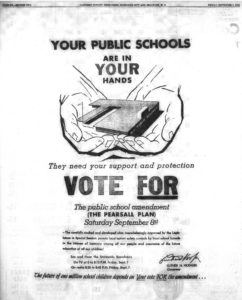
Pearsall Plan is Formed

In April 1956, the Pearsall Committee released the “Pearsall Plan to Save Our Schools”, a report with recommendations based on the research that members of the Pearsall Committee had conducted. The plan included voluntary school assignment, a tuition grant system, and eliminated attendance requirements for students who were assigned to an interracial school against their wishes.

1957
September 4
First Black Student at All-White Charlotte Schools

On September 4th, 1957, Dorothy Counts becomes the first Black student to attend a predominantly white school in North Carolina, Harry Harding High School in Charlotte. Counts was met with intense resistance and violence from white students, parents, and administrators alike. Dorothy Counts discusses her first day of school:

Public School Forum · Dorothy Counts Discusses Her First Day at Harry Harding High School

(more…)

1960
February 1
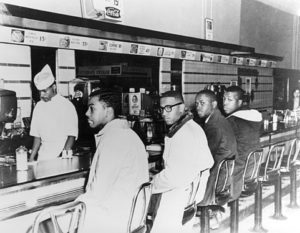
Woolsworth Sit-Ins Begin

In February 1960, four Black students from North Carolina Agricultural and Technical college sat at the segregated whites-only lunch counter of Woolworth’s five-and-dime in Greensboro, North Carolina. This launched the sit-in movement across the nation, and began the process of the desegregation of public spaces across the South.
 

1963
September 15
16th Street Baptist Church Bombing

In September 1963, the 16th Street Baptist Church in Birmingham, Alabama was bombed, killing four Sunday School children. This event, in combination with earlier instances of violence in Birmingham that spring, shocked the nation and made Civil Rights in America an international issue.

1964
July 2
Civil Rights Act is Passed

In July 1964, President Lyndon B. Johnson signed the Civil Rights Act into place, outlawing discrimination on the basis of race, color, or national origin. Titles IV and VI dealt explicitly with education: Title IV commissioned the Coleman report on educational opportunity and equity, and Title VI permitted the withholding of funds from school districts who refused to comply with the Brown ruling.

1965
April 11
Elementary and Secondary Education Act is Passed

The Elementary and Secondary Education Act (ESEA) is passed in April, 1965 as part of President Johnson’s War on Poverty. This Act gave the Civil Rights Act the ability to actually withhold federal funding for noncompliant districts.

1966
July 1
Coleman Report is Released

In 1966, a report titled The Equality of Educational Opportunity (also known as the Coleman Report) is released. This report was commissioned by the Civil Rights Act to study educational opportunities and outcomes for students of color. The report found that there was a significant achievement gap between Black and white students. The Coleman Report would continue to be pivotal in many desegregation Supreme Court cases.

1968
April 8
Martin Luther King Jr. Is Assassinated

In April 1968, Civil Rights leader MLK Jr is assassinated. As protests spark across the country, the Nixon campaign seizes on the idea of “law and order”, and public opinion shifts away from favoring increased civil rights for Black Americans.

April 11
Fair Housing Act is Passed

In April 1968, President Johnson passes the Fair Housing Act, which prohibited discrimination concerning the sale, rental, and financing of housing based on race, religion, national origin, sex. This was a crucial step for school desegregation, as it is often a student’s neighborhood that determines where they will attend school. 

November 5
Richard Nixon Elected President

Richard Nixon is elected as president, campaigning on the “Southern Strategy”, focusing on rhetoric of “law and order” and increasing racial fears of white Republicans. Nixon would go on to appoint four Supreme Court justices that would make key decisions regarding desegregation.

1969
July 8
Godwin v. Johnson County

In July 1969, Godwin v. Johnson ruled that the state of North Carolina was in charge of desegregating schools–not the individual localities.

1970
January 2
Dr. Dudley Flood Begins Desegregation Work at DPI

Civil Rights leader and school desegregationist Dr. Dudley Flood began his position at the North Carolina Department of Public Instruction on January 2nd, 1970. Dr. Flood, along with his colleague Gene Causby, traveled across the state as representatives of DPI to meet with school districts who were struggling with how to desegregate their local schools. Here, Dr. Flood discusses the responses that communities had to desegregation plans, specifically school closures:

Public School Forum · Dr. Flood on Community Response to School Desegregation

Listen to Part I and Part II of the full interview, or read the full interview transcript.

[learn_more caption=”Audio Transcript”] “There was no one way that you would characterize their behavior, but there were several things that you could anticipate. The first is that you’re asking people to make a change, and it’s very rare that you meet anybody who wants to make a change. So you had to devise a matter of analyzing change for them. And there are three elements of that that you have to analyze. First of all, how pleased are you with what you now have? Secondly, what is the specific change you’ve been asked to make and thirdly what will be different and better? When you shall have made that change, unless those three things are in place, you continue to have this kind of annuity between what the law says or the policy says and what people are actually going to do. If, for example, your plan called for closing the school, which it often did, you closing the black school or move all the kids to the previously white school. They are grandmothers and mothers sometimes who aren’t in that school. It was the definition they had for what school is and then many communities, particularly in many black communities, the school’s the center of the community. It was the one thing around which everyone coalesced. It was the social life, it was the educational life and everything else that was meaningful to them. So the identity with that school was way beyond just education, way beyond that.”[/learn_more]

1971
April 7
Swann v. Charlotte Mecklenburg Board of Education

In April 1971, the Swann case challenged the Pearsall Plan and ruled that busing was a legitimate and useful tool for desegregation. School districts across the nation would cite this ruling for decades to come when implementing their own busing plans.

1974
July 25
Miliken v. Bradley Decision

In July 1971, the Supreme Court ruled in Miliken that schools were not responsible for busing students to other schools across district lines. This set a long precedent that schools could not desegregate across district lines–a larger issues for de facto segregated districts in the North that could have dozens of districts within a single county.

1991
January 15
Board of Education Oklahoma City v. Dowell

In January 1991, Board ruled that once a school district became racially “unitary”, schools that were no longer identifiably “Black” or “white”, then they could be released from court-mandated desegregation practices such as busing.

1994
May 25
Leandro v. State of North Carolina Lawsuit is Filed

In May 1994, five districts in low-wealth counties filed a lawsuit against the state, arguing that despite the fact that they were being taxed at higher-than-average rates, their school districts did not have enough funds to provide an equal education for their students. 25 years later, the Leandro case continues to be one of the biggest issues within North Carolina education policy. Learn more about the Leandro case here.

1996
June 21
Charter Schools Act is Passed

The Charter Schools Act of 1996 is passed, authorizing the formation of up to 100 charter schools in the state of North Carolina. The act also limited districts by stating that no district could have more than 5 charter schools. This act signified the beginning of the school choice movement in NC, and the provision of alternative options to the traditional public school.

1997
July 24
Leandro Case Ruling

In 1997, the North Carolina Supreme Court declared that North Carolina was obligated to provide its students a “sound, basic education.”

1998
August 15
Lawsuit Filed to Challenge Charter School Diversity Requirements

In 1998, the nonprofit group North Carolina Foundation for Individual Rights filed a lawsuit to attempt to block the state’s diversity requirement for charter schools. NC laws state that the racial makeup of charter schools must “reasonably reflect” the community they serve. As a result of this lawsuit, North Carolina decided not to continue to enforce this racial diversity rule. At the time of the lawsuit, North Carolina’s charter schools served predominantly Black students. 

1999
September 9
Capacchione v. Charlotte-Mecklenburg Schools Ruling

In 1997, William Capacchione, a white parent, filed a lawsuit against CMS on behalf of his daughter Christina stating that she was not admitted to a magnet school of her choice due to her race. In 1999, the judge ruled that CMS must stop using race as a category for pupil assignments to schools within the district. The judge also ruled that Charlotte has been compliant with the Swann ruling and “has achieved unitary status in all respects,” and no longer needs to be under court-ordered desegregation.

2001
September 21
Belk v. Charlotte Mecklenburg Schools Ruling

Following the Capacchione case and the declaration of CMS as “unitary”, a group of Black families filed a motion to reactivate the Swann case, arguing that CMS had not officially reached unitary status, and that maintaining desegregated schools was crucial to the quality of their children’s education. However, the United States Court of Appeals Fourth Circuit found that CMS had indeed ended their segregated system of schooling, and had achieved unitary status.

2004
July 30
Leandro II Ruling

This second Leandro ruling affirmed the “Leandro Tenets” necessary to receiving a sound, basic education. It also ruled that the state was in violation of providing a sound, basic education, and that it was not possible to achieve this by transferring educational responsibility to localities.

2007
June 28
Parents Involved in Community Schools v. Seattle School District No. 1 Ruling

Parents Involved in Community Schools (PICS) v. Seattle ruled that the use of student’s race in pupil assignment was unconstitutional. This would affect school districts across the nation that were using the racial identity of a student as a factor in school assignment as a measure of desegregation.

2011
February 24
Senate Bill 8 is Passed

In February 2011, Senate Bill 8 was passed, lifting the 100 charter school cap put in place by the previous 1996 Charter School Act. The cap was lifted in order to receive federal funding from the Race to the Top program. This led to a rapid increase in charter schools across the state, which have demonstrated in recent years to be increasingly more segregated than traditional public schools, and in North Carolina, serve primarily white students. In these districts, charter schools effectively segregate traditional public schools.

2015
September 23
House Bill 334 Passed

In September 2015, the North Carolina General Assembly passes HB 334, which permitted the creation of a weighted lottery system to be used by charter schools to promote socioeconomic diversity within the school. As of the 2018 school year, only 4 charter schools in the state have utilized this program.

2017
November 15
Governor Cooper Created Commission on Access to Sound Basic Education

In November 2017, NC Governor Cooper issued Executive Order 27, which created the Commission on Access to Sound Basic Education. The mission of the Commission is to assess the state’s ability to staff schools with highly effective teachers and principals, and the state’s commitment to providing adequate resources for all students.

2018
March 13
Judge Lee Commissions WestEd Report

Judge David Lee, the judge presiding over the Leandro case and the person responsible for making sure that North Carolina implements the decision in the case, ordered an independent report on the state of education in North Carolina. Lee commissioned WestEd, a nonprofit, nonpartisan research agency to study the issue and recommend a plan of action for the state.

2019
December 10
WestEd Publishes Report

In December 2019, WestEd released its report to the public. The report titled Sound Basic Education for All: An Action Plan for North Carolina, included 8 detailed recommendations of how North Carolina could comply with the Leandro orders.

2021
March 15
Comprehensive Remedial Action Plan Submitted to Court

Comprehensive Remedial Action Plan

On March 15th, 2021, the comprehensive remedial action plan for the Leandro case was submitted to the Superior Court. This plan addresses the ways in which North Carolina can meet its constitutional obligation to provide every student with a sound, basic education.

Footer

Contact

Public School Forum of North Carolina
PO Box 18284
Raleigh, NC 27619
919-781-6833
info@ncforum.org

Our Mission

For nearly 40 years the Public School Forum of North Carolina has served as an indispensable and nonpartisan champion of better schools. We bring together individuals and institutions from business, education and government to study education issues, develop ideas, seek consensus, and ultimately inform and shape education policy.

  • Bluesky
  • Email
  • Facebook
  • Instagram
  • LinkedIn
  • Twitter
  • YouTube

Copyright © 2026 · Public School Forum of North Carolina

All Rights Reserved · Website by Tomatillo Design