After a year of waiting, the North Carolina General Assembly (NCGA) and Governor Josh Stein have passed a comprehensive state budget, and this compromise comes with a sense of relief for many. Indeed, there are policies and much-needed funding to celebrate within it. However, the final legislation– over 600 pages long– also includes numerous policy provisions beyond appropriations that have been priorities of legislative leadership.
Long-awaited teacher raises are significant for beginning teachers, yet regressive for many veterans. Important investments are made in student well-being, yet other policies stand to negatively impact the well-being of some of our most vulnerable populations. The budget reflects a series of tradeoffs that will shape the state’s capacity to invest in its students, educators, and communities for years to come. Critically, the final budget offers short-term tax relief for some, which may ultimately constrain future investments in public schools and the services that support students and families.
- Educator Compensation. Recruitment and Retention
- Student Well-Being
- Released Time for Religious Instruction
- Artificial Intelligence (AI) Expansion in Schools
- Private School Vouchers
- Taxes and State Revenue
Educator Compensation. Recruitment and Retention
Teacher Raises Fall Short, Especially for Veteran Educators
At the start of the 2025-26 school year, there were over 1,500 vacant K-12 teaching positions and 631 vacant special education teaching positions across the state. The previous school year, the state lost more than 9,000 teachers with beginning, residency licensed, and temporary licensed teachers having the highest attrition rates. With the number of people enrolling in educator preparation programs (EPP) decreasing each year and declining program completion rates, schools are losing teachers at a faster rate than gaining them. The budget provides an attempt to address one part of the shrinking pipeline problem (recruitment) while falling short of policies to solve retention challenges.
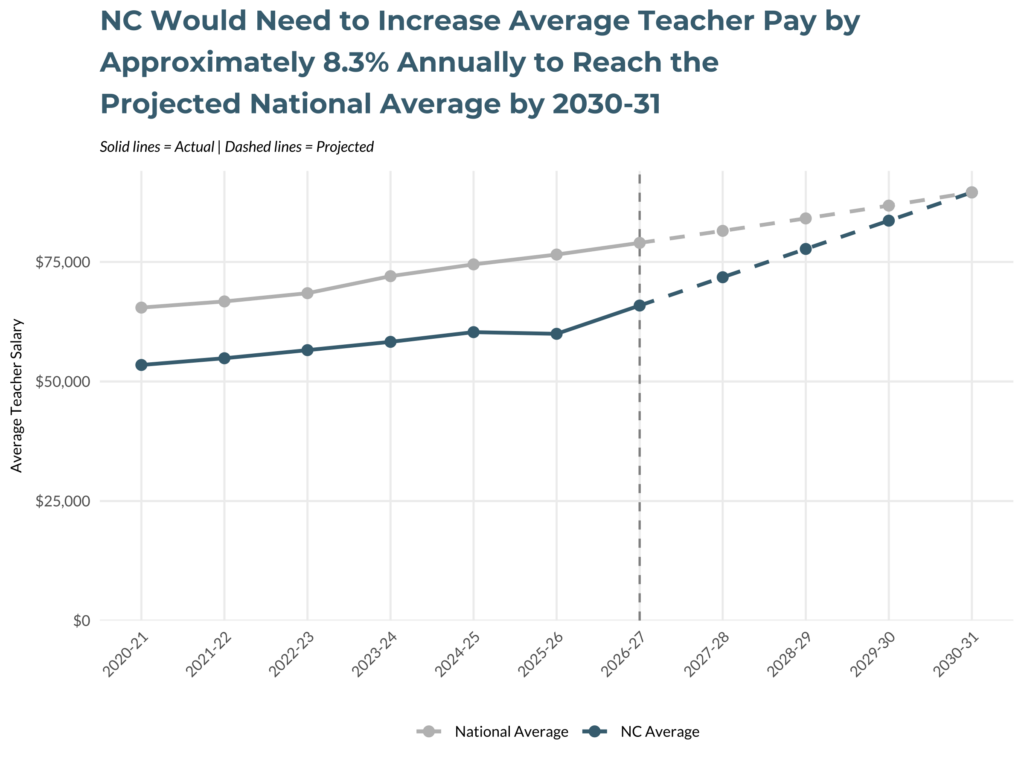
The new salary schedule establishes a starting teacher salary of $48,000, with an average raise of approximately 8 percent across the salary schedule, weighted more heavily towards early-career teachers. While this is a substantial improvement and stands to make North Carolina’s beginning teacher pay more competitive with other states, when adjusted for inflation, our new starting teacher salary remains below what beginning teachers earned a decade ago. Although nominal salaries increased, purchasing power has not kept pace with rising cost of living.
The salary schedule for teachers still includes a significant pay plateau between years 15-24, with salaries effectively capped after 25 years of service. Veteran teachers continue to receive little recognition for their experience beyond small annual adjustments and one-time bonuses, making it increasingly difficult to retain experienced teachers who are essential to mentoring new educators and strengthening school communities.
The budget includes a one-time bonus of $1,000 for teachers with 16 or more years of experience and $500 for teachers with 15 or fewer years of experience. While these bonuses may provide temporary financial relief, they do not address the root of the problem– teachers in North Carolina often struggle to make ends meet due to low salaries.
Efforts to Address Teacher Recruitment and Retention
The budget invests in teacher apprenticeships as a pathway into the profession, in an effort to strengthen the teacher pipeline. However, the budget does not include the restoration of Master’s pay for teachers who earned advanced degrees after the 2013 policy change, maintaining a disincentive and lack of recognition for teachers seeking additional professional preparation and specialized expertise.
Intended to improve teacher recruitment, retention, professional growth, and student outcomes, the budget expands investment in Advanced Teaching Role (ATR) supplements and grants by $32 million for a total of $48.4 million funding the program. The expansion supports salary supplements for varying ATR leadership roles.
ATR is not a statewide salary increase for teacher leaders. It is a targeted career pathway available only in participating districts and schools. While the budget expands funding for ATR, these supplements benefit a relatively small subset of educators who meet the qualifications. While this program is a valuable complementary strategy for teacher leadership and retention, it is not a substitute for critical systems-level improvements to the statewide teacher salary schedule.
Principal Salary Includes Disruptions in Monthly Installments of Performance Supplements
The budget provides principals with a 3 percent salary increase while maintaining the existing compensation structure based on average daily membership (ADM) and school performance. Principals continue to qualify for higher salary schedules based on whether their schools meet or exceed academic growth, and the budget also provides recruitment and retention supplements for principals who remain in low-performing schools for up to three years.
Principals who qualify for the Met Growth or Exceeded Growth supplements receive their full annual salary through equal monthly paychecks from July 2026 – December 2026. Beginning in January 2027, principals will drop to base-only monthly pay, and will receive a single lump-sum supplement in January covering the second-half difference between base and supplemental schedule in one payment. While this change does not have an immediate impact on principals, nor does it reduce total compensation, it alters the timing of earned salary and may create challenges for principals who have historically relied on consistent monthly income. Questions regarding stability and longer-term impact remain.
The budget fails to address broader concerns with North Carolina’s principal compensation model, which relies heavily on school size and academic growth rather than critical factors like school complexity, student need, or other increasing responsibilities principals face. Modernizing principal compensation to better reflect the realities of school leadership remains an important unfinished policy priority.
Student Well-Being
With new incentives, districts will be encouraged to opt into the Community Eligibility Provision, a federal program that enables schools to provide free breakfast and lunch to all students. Schools will also be required to provide the same meal options to all students, regardless of pay status, reducing the stress and stigma that has persisted at mealtimes for many kids.
The budget also appropriates $3 million to sustain and expand the North Carolina Community Schools model, which connects students, families, educators, and community members to bring together the services and resources needed for students to thrive. This model has been proven to strengthen academic, health, and behavioral outcomes, reduce absenteeism, and support educator retention.
Students will also have more direct access to the Suicide and Crisis Lifeline, as well as the Peer Warmline. With these phone numbers displayed in highly-used and referenced spaces like school IDs, school-issued electronic devices, and agendas, students in need of mental health support will have more resources at their disposal. As our youth continue to face rising rates of depression and suicide has become a leading cause of death, these resources become even more critical.
We commend these important steps toward supporting student health and well-being. However, the first and most critical support for student mental health is through school counselors, social workers, and psychologists. In North Carolina, the number of school mental health professionals has persistently been below the recommended ratios, as indicated by regular and required reporting to the NCGA. This budget will repeal the mandatory reporting that shows the number of educators in these positions, impeding efforts to monitor and address student needs effectively.
The budget also requires local school boards to establish a new Community Advisory Committee made up of educators and parents to review challenges to books and other instructional materials available to students. Questions have been raised regarding the necessity of another advisory committee, as most districts have already put review measures into place in compliance with the Parents’ Bill of Rights. The materials most frequently called into question reflect the identities of LGBTQIA+ students and students of color.
Released Time for Religious Instruction
This budget also adds religious instruction (RTRI) to the list of excused absences from school. For up to four hours each week, a student may miss academic instructional time to attend private religious instruction provided off-campus. Teachers must provide students with an opportunity to make up any schoolwork missed, and local school boards will be required to draft local policy allowing for RTRI. Districts will need to draft consent paperwork and processes and coordinate transportation with the private religious entities.
As seen in other states with similar policies, educators and school leaders can anticipate disruption to the school day, lost instructional time, new logistical challenges, and questions about safety (legislation does not require background checks for religious instruction leaders, for example). This provision takes decision-making power away from local governments, lacks sufficient guardrails to protect students, and is likely to cause disruptions to the regular school environment.
Artificial Intelligence (AI) Expansion in Schools
The conference budget advances a number of AI initiatives for public schools, including $5 million in recurring funding for schools to purchase Khanmigo and MagicSchool for use in grades 6-12. Each of these products is an AI tool designed to assist both teachers with lesson plans and students with lesson comprehension. However, significant questions remain about the effectiveness of these tools and data privacy concerns. The budget requires the Office of Learning Research at the North Carolina Collaboratory to study the effectiveness of each of these tools by April 1, 2028. It is worth noting that there was no competitive bidding process for either of these contracts.
The budget also requires the State Board to adopt age-appropriate standards for AI literacy in grades K-12. Unlike the standard five-year review cycle, the State Board is required to review AI literacy standards annually to keep up with advancements in AI. These standards will live in the standard course of study for computer science and will be implemented in the 2028-29 school year.
Finally, the budget requires all local boards of education to adopt a policy on the use of AI for students and staff, based on a model developed by the North Carolina Department of Public Instruction. All educators must complete AI professional development, provided by the Friday Institute, by June 30, 2028.
Private School Vouchers
This conference budget continues the trend of expanding privatization efforts in education. It does not change planned appropriations to the state’s taxpayer-funded private school voucher program, meaning that the state will appropriate $705 million to the Opportunity Scholarship Program in 2026-27. This is an increase from the $655 million appropriated in 2025-26, and by 2030, the state will appropriate over $800 million annually.
The NCGA has stated its intention of reinvesting savings from the Opportunity Scholarship Program back into public schools. The savings are defined as the difference between the average State per-pupil allocation for ADM and the cost of the private voucher for a student who transfers from a public school to a private school. This budget outlines its plan to reinvest the $35.8 million due to districts for the 2024-25 and 2025-26 school years, including $17 million for a one-time bonus for school nutrition and custodial staff, $14 million for middle school literacy professional development, and $10 million for a new K-8 math curriculum.
Taxes and State Revenue
Salary increases for educators and other investments made in this budget are welcome and long overdue. However, they do not erase the long-term damage that will be caused by tax cuts and lost revenue for our state, locking North Carolina into permanent underinvestment due to state revenue loss.
Taxes have been at the heart of our budget stalemate over the past year or two, as House and Senate leadership in the NCGA have disagreed on whether or not to continue as planned with cuts to personal and corporate income taxes. In its final form, the budget includes a reduction to the personal income tax rate from 3.99 to 3.49 percent in 2027, and a revised timeline to protect state revenue over the next three years. The rate can still lower to 2.49 percent if certain revenue triggers are met between 2035 and 2040. There is no change to the scheduled elimination of the corporate income tax by 2030.
Paired with proposed constitutional income and property tax caps that will be on the ballot in November, North Carolina faces a future of fewer choices, fewer public investments, and a greater wealth gap. These tax policy changes carry significant long-term implications: reduced state revenue estimated to cost the state billions annually. Furthermore, new limits on local taxing authority could make it harder for state and local governments to fund public schools and other public services in the future. In many communities, local governments have already taken on increased financial responsibility as the state has fallen short of fully funding public education and continues to pass along additional costs through unfunded mandates. Limiting local revenue flexibility could further constrain counties’ ability to provide the services residents rely on each day, including school funding, public safety, and infrastructure.
Conclusion
North Carolina’s economy depends on public investments that help people work, learn, care for their families, and participate fully in their communities. Our 2026 budget is more than just a spending agreement for the fiscal year.
We must ask ourselves: does the vision for North Carolina’s future presented in this budget align with the future that we envision for our children? Will the tax cuts providing short-term benefits for some be worth the limits they place on our state’s ability to prepare for growth and respond to crises for all?
While the budget provides some meaningful and much-needed investments, existing and pending tax policy changes put the future of our public school students at risk. Realizing a future where students learn together, communities are invested in their local public schools, and all kids and communities have the opportunity to thrive will require sustained, long-term and systemic investments and commitment from lawmakers.
Leave a Reply